London
The Cuckoo's CallingLondon is the novel’s central setting, a city experienced at once as a bewildering maze, a refuge of anonymity, and a crowded stage on which private grief becomes public spectacle. Its changing scale—from Robin Ellacott’s uncertain navigation of Oxford Street to Cormoran Strike’s effort to find solace in the city’s vastness—gives physical form to the characters’ changing circumstances. Streets, transport, building works, and the Thames also intersect with the investigation itself, turning the urban environment into both evidence and pressure.
First Impressions and Everyday Navigation
For Robin, London initially feels vast and difficult to read. Newly arrived from a small Yorkshire town, she is temping while living with her long-term boyfriend, Matthew, and has to find her way to a week-long secretarial assignment using an agency’s poorly drawn map. Construction barriers and plastic walls obscure the landmarks, and she is unsure whether relying on the map makes her look any less like a newcomer. Her route takes her past the Center Point office block and towards Denmark Street, placing the city’s confusing scale directly in the path of her new working life.
That morning, however, Robin sees London through the happiness of Matthew’s proposal. He has proposed shortly after midnight beneath the statue of Eros at Piccadilly Circus, after abandoning his original plan in a restaurant when another couple overheard them. His uncharacteristic public gesture, the sapphire ring set with two diamonds, and the story of the plan that went awry make the city feel newly welcoming to her. On the commute, she keeps looking at the ring and imagines buying bridal magazines; even the commuters around her seem transformed by her excitement. London is therefore introduced not as a fixed experience but as a place whose meaning changes with the person moving through it.
A Refuge of Scale and Anonymity
Strike’s relationship with the city is shaped by exhaustion, financial difficulty, and the loss of the life he previously knew. After spending an afternoon showering at the University of London Union and looking for necessities with Bristow’s money, he returns to his office carrying a boxed camp bed. The walk along Oxford Street, among closing shops and illuminated pub windows, gives him a temporary sense of comfort: London’s old buildings and immense population make his private distress feel less singular. He finds solace in the city’s vastness and anonymity, even as the pain of the walk makes his immediate circumstances impossible to ignore.
The next Sunday, Strike uses the same university facilities to shower, taking care not to draw attention to his prosthetic leg. From there he travels to Hammersmith, where a bustling commercial center lies only a short walk from a quiet stretch of the Thames. The contrast recalls childhood Sundays in Cornwall with his sister, Lucy: the closed shops, church and beach, family meals, and the quiet of St Mawes. London’s capacity to contain both crowded commercial life and quieter margins brings those memories into the present without making the city feel like home in the uncomplicated sense.
Neighborhoods, Encounters, and Investigation
The city’s sharply different districts accompany Strike’s movement between interviews, evidence, and private reflection. After speaking with people connected to Rochelle Onifade in Hammersmith, he walks towards Hammersmith Bridge and follows the riverside path beside terraced houses. At the Blue Anchor he sits outside with a drink and reads a newspaper story about Evan Duffield’s visit to Lula Landry’s mother. The image and brief report connect the river’s relative quiet to the press coverage that continues to follow the case.
Other journeys expose equally stark contrasts. To meet Lula’s biological mother, Marlene Higson, Strike travels to Canning Town. Canary Wharf’s sleek towers are visible from the station, but a short walk leads him into a deprived area far removed from the polished corporate landscape. The meeting is arranged at the Ordnance Arms, beside a pawnbroker; its utilitarian interior and concrete beer garden, surrounded by high walls and blocks of flats, give the interview a markedly different setting from the affluent world associated with Lula’s celebrity. London’s proximity of wealth and deprivation is made tangible in the distance between the view from the station and the pub where the conversation takes place.
Construction repeatedly interrupts Strike’s routes around his Denmark Street office. At the junction of Tottenham Court Road and Charing Cross Road, excavations, temporary walkways, fences, and tunnels turn familiar streets into a difficult passage. On one such journey, tired and in pain, Strike detours from the worksite and calls Rochelle; the call reaches her real voicemail, but he leaves no message. The altered streets mirror an investigation in which familiar appearances cannot be taken at face value, while the city’s practical obstacles repeatedly slow the detective’s progress.
The investigation also depends on how people move through London and what the city’s surveillance captures. In reconstructing Lula’s death, Strike explains that John Bristow used Deeby Macc’s hoodie and ran through the street after leaving the flat. A camera recorded Bristow and another man running along Halliwell Street, but there were no further cameras on the route beyond it. Elsewhere, Strike revisits Derrick Wilson’s search of the flat and the stairwell, where Wilson remembers slipping on water. Strike’s reconstruction identifies the water as drops left from roses Bristow had carried from another flat; Wilson’s fall becomes a consequence of that trace. The city supplies both the gaps that allowed the killer to escape further observation and the limited footage that helped expose his movements.
Public Spectacle and Private Exposure
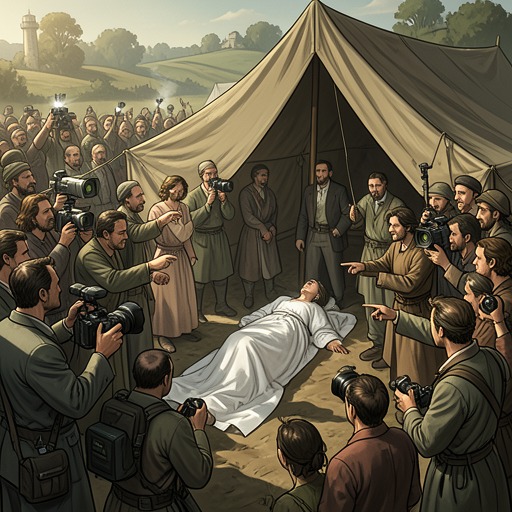
London’s streets are not simply anonymous. The press can turn them into a gauntlet, as Strike discovers while travelling with Duffield. Photographers run alongside their car, and motorbikes follow it; another crowd waits around a corner, ready to photograph the passengers as they get out. The pursuit recalls the cameras that had surrounded the ambulance carrying Lula’s body. In this urban setting, publicity is not an abstract story printed in newspapers: it is a physical presence that follows the people involved and makes ordinary movement difficult.
The contrast between public attention and personal isolation is especially clear in Strike’s return to Denmark Street. Looking out at Charing Cross Road on a Friday night, he sees the city’s revellers while feeling that his former social life belongs to another world. He has lost the army, his relationship with Charlotte, and part of his leg; Robin is his only real human contact, but he is not yet ready to resume ordinary social life or face other people’s reactions. London’s crowds can soften the feeling of being alone, as they do on Oxford Street, but they can also sharpen it by surrounding a solitary person with lives that appear to continue without him.
By the investigation’s end, the city has connected professional consequences with a developing personal bond. The publicity surrounding John Bristow’s arrest benefits Strike’s business, while Robin prepares to leave for Yorkshire with Matthew. Strike wonders whether he will see his temporary secretary again and recognizes that he will miss her. As he returns through the continuing building work, he hears Robin arranging appointments on the telephone. London remains a place of obstruction and upheaval, but also the setting in which their working relationship has become important enough to survive the case that brought them together.